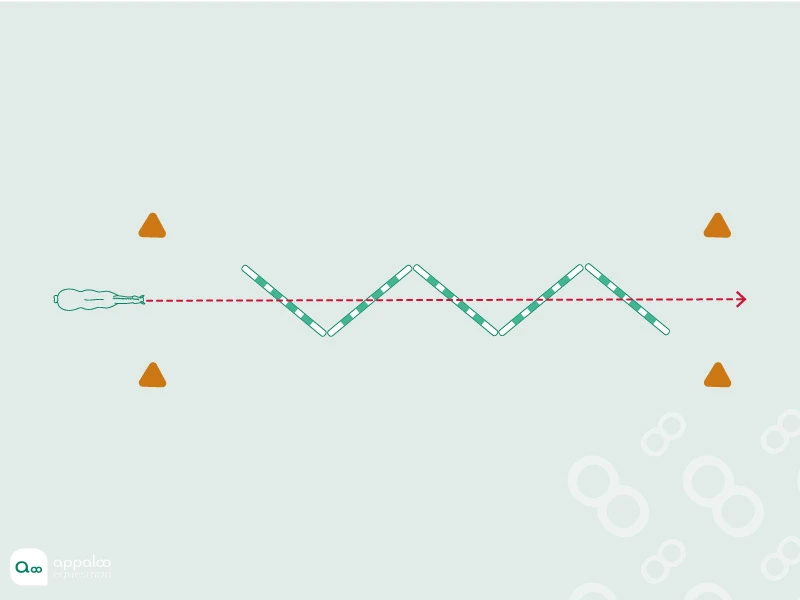
Cavalettis | Hard
Work on diagonal jumps and straightness

 Unicorn
0 comments left · 1 published riding session
Cavalettis | Hard
Work on diagonal jumps and straightness
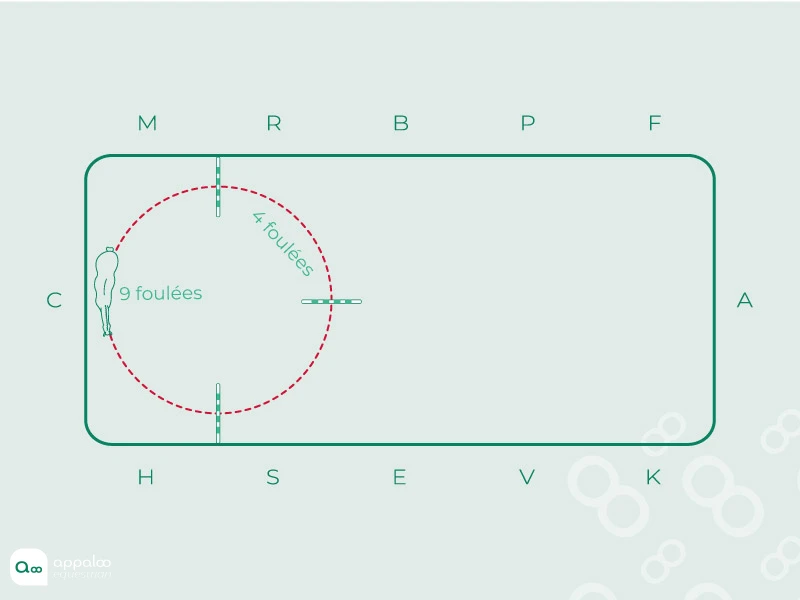
Dressage | Medium
Manage stride length and rhythm on a curve
 PREMIUM
Groundwork | Medium
The objective of this exercise is to work on the horse’s motivation for the jump.
 PREMIUM
Groundwork | Easy
The objective here is to prepare the mounted water jump and to help your horse approach it calmly, so that jumping at competitions is no longer intimidating.
 PREMIUM
Groundwork | Easy
In this exercise, we will teach the horse to jump calmly, so that when you later ask him under saddle, he already has a confident foundation.
 PREMIUM
Groundwork | Easy
This exercise is often feared or even avoided, because we tend to believe that show jumping horses should never step into the water. Fake news! In this exercise, you’ll teach your horse to walk on a tarp so that later on, you can safely introduce jumping a water tray.
 PREMIUM
Groundwork | Hard
This exercise helps your horse: - Challenge his lateral balance - Activate the thoracic sling alternately left and right by shifting his body weight first onto the right shoulder, then onto the left
 PREMIUM
Lunging | Easy
This exercise helps your horse to: - Challenge his lateral balance, engaging his thoracic sling alternately to the right and left - Challenge his longitudinal balance, also engaging the thoracic sling - Take responsibility for maintaining his own balance
 PREMIUM
Groundwork | Easy
Not every horse is born understanding ridden work, so it’s important to teach him how to step over a ground pole without stress and with attention. The goal of this exercise is to help your horse release tension and learn to cross each pole calmly and mindfully.
 PREMIUM
Lunging | Medium
Linking tight curves and straight lines on the lunge helps to: - challenge the horse’s lateral balance (and therefore engage the thoracic sling alternately on each side) - encourage the horse to take responsibility for maintaining his own balance
 PREMIUM
Lunging | Easy
or your horse to properly engage his thoracic sling, you’ll need him to be: - relaxed - in a rather low-head posture The spiral exercise helps develop lateral balance, which means the horse mobilizes his thoracic sling alternately on the right and left sides. Because this exercise involves riding on curves, often quite tight ones, be careful not to ask for it too long or too often. If your horse is young, has trouble finding his own balance, or has physical issues that show up on tight curves, limit this exercise to a few minutes each direction and prioritize wide curves (like the large spiral).
 PREMIUM
Dressage | Easy
Serpentine patterns are excellent exercises to challenge the horse’s lateral balance and therefore the tone of his thoracic sling, thanks to the continuous alternation from right to left.
 PREMIUM
Dressage | Medium
Variations in frame and head height help challenge the horse’s balance and therefore the tone of his thoracic sling.
 PREMIUM
Dressage | Medium
La variation d'amplitude est un excellant indicateur de la tonicité de la sangle thoracique. Cette variation met l'équilibre du cheval à l'épreuve et lui demande donc de "se tenir" donc de maintenir son centre de gravité, et donc de solliciter sa sangle thoracique.
 PREMIUM
Dressage | Customizable
The walk-trot transition is a good indicator of the tone of the thoracic sling. If your horse tries to avoid using its thoracic sling, the quality of your transition will suffer.
 PREMIUM
Groundwork | Hard
Perform a complete sequence of lateral movements over various obstacles, aiming for maximum fluidity, precision, and connection with your horse.
 PREMIUM
Groundwork | Medium
Cue and refine lateral movements until your horse can perform them over a ground pole, to improve precision, hoof control, and desensitisation.
 PREMIUM
Groundwork | Easy
Learn to obtain smooth and light lateral movements on the ground, starting from good hip control and a fine response to the stick cues.
 PREMIUM
Long rein | Medium
Be able to perform a figure-eight at the trot with two equal circles, including a transition to a halt, then backing up at the center of the figure-eight.
 PREMIUM
Groundwork | Easy
Teaching the horse to move backward toward you by aspiration, meaning to step back while coming toward the human located behind him.
Please sign in to save your favorites.