R+ in equestrianism: positive and negative reinforcement and punishments explained simply
R+ in horse riding means positive reinforcement: we add something pleasant (a treat, a scratch) immediately after a behavior so that the horse repeats it more often. On the other hand, R- (negative reinforcement) consists in removing something unpleasant, most often pressure, to obtain a desired behavior.
We are hearing these terms more and more around the stable or on social media, along with their friends P+ and P-… but what do they really mean?
They come from learning theory, and more specifically from operant conditioning described by psychologist B.F. Skinner. These four mechanisms explain how your horse learns.
We'll explain it all simply, with illustrations, everyday examples, and what science has to say about it.
Positive or negative: it doesn't mean “good” or “bad”
This is THE vocabulary trap. In learning theory, “positive” and “negative” have nothing to do with a moral value: they are mathematical signs.
Positive (+) = we add a stimulus.
Negative (−) = we remove a stimulus.
And the second word tells us what we are trying to achieve:
Reinforcement = we want to increase a behavior.
Punishment = we want to decrease a behavior.
By combining the two, we get four categories: R+, R-, P+ and P-. R- is therefore not “bad”, and R+ is not automatically “kind”. What matters is paying attention to the signals your horse sends you so you can adapt the way you teach them things.
Positive reinforcement (R+): adding something pleasant
R+ consists in adding a pleasant stimulus to increase a behavior. In horse riding, this stimulus is often a treat or a scratch.
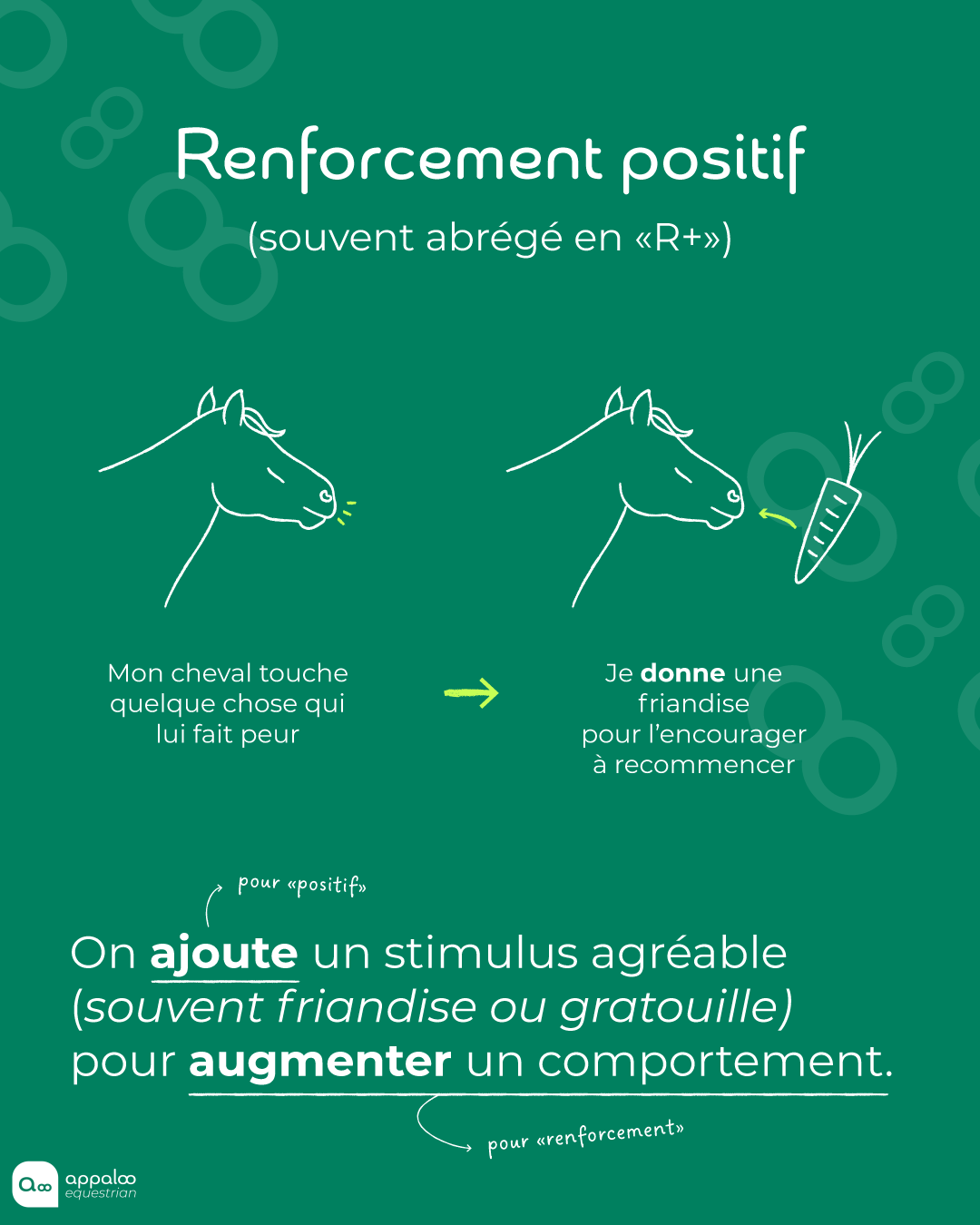
Example: your horse dares to touch an object that scares him with the tip of his nose. You immediately give him a treat. Result: he is more willing to try again, and the object becomes less frightening.
Other situations where R+ works really well:
learning to touch a target (the “target”);
picking up his feet or standing still for the farrier;
loading into the horse trailer without stress;
accepting the hose, spray or clippers.
The keys to using R+ effectively:
Timing. The reward must come immediately after the desired behaviour. A few seconds’ delay, and your horse associates the treat with something else.
A marker. A click or a “Yesss” precisely says “that’s it!” at the exact moment, even if the treat arrives a second later (we’ll come back to this below).
The right reward. It must be valuable to YOUR horse. One study showed that patting the neck has a very weak reinforcing effect, or none at all (Takahashi et al., 2016).
Clear rules around food. Only reward after the marker, never when he rummages through your pockets: that is what prevents a “begging” horse.
Negative reinforcement (R-): removing pressure
R- consists of removing an unpleasant stimulus to increase a behaviour. In riding, this stimulus is most often pressure: leg, rein, lunge line or stick.
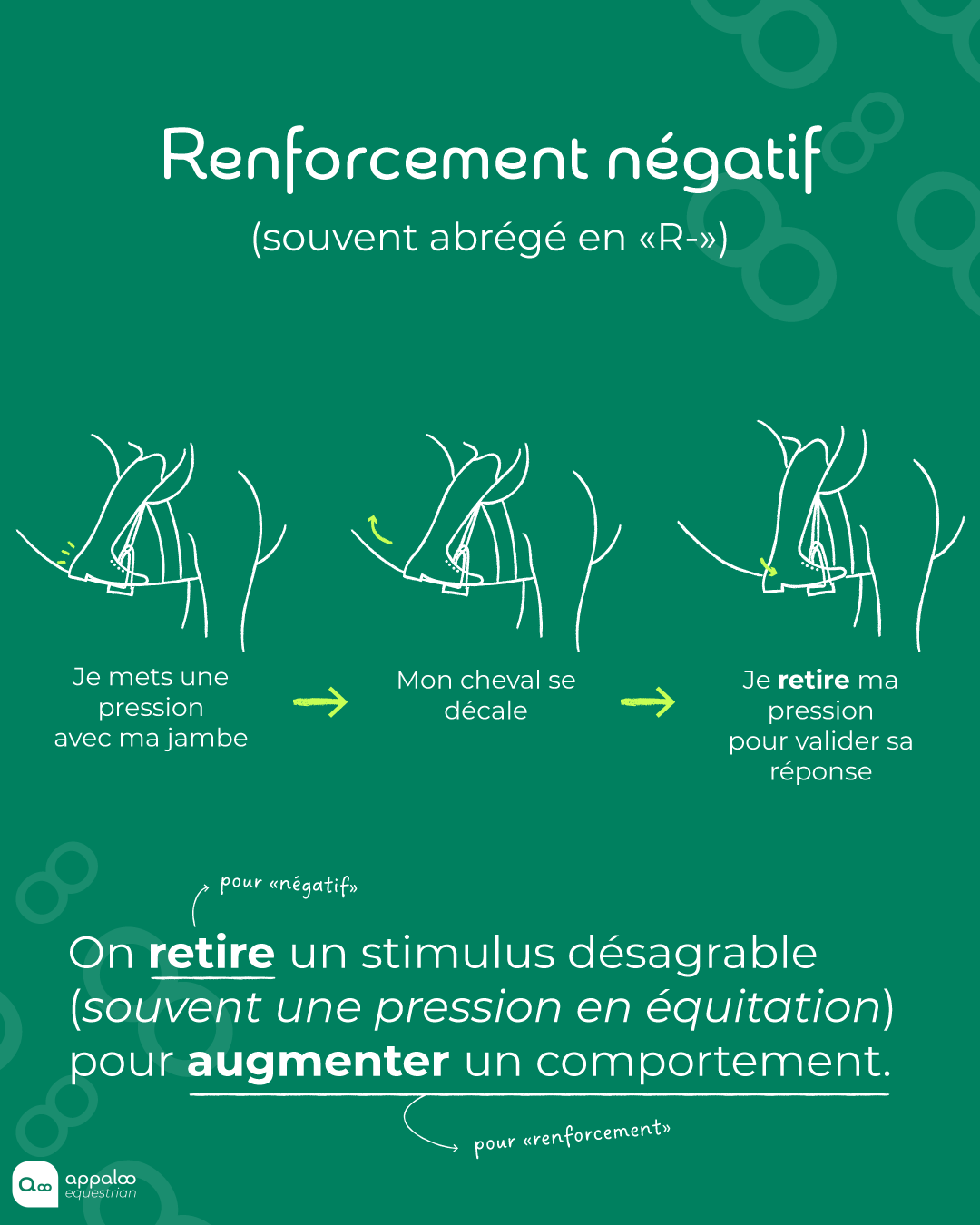
Example: you apply pressure with your leg, your horse moves sideways, and you immediately release your leg to mark his response. It is not the pressure that teaches the horse, but the release: he understands that moving sideways makes the discomfort go away.
Negative reinforcement is the foundation of «classical» riding: most of our aids work this way, both from the ground and under saddle. When used correctly, it makes it possible to progress towards increasingly lighter aids (McLean & Christensen, 2017).
The keys to correct negative reinforcement:
Release at the right moment, as soon as the horse responds, even just a little.
Start lightly, then increase progressively only if necessary, and decrease again as soon as possible.
Never maintain continuous pressure: without release, the horse has no way of knowing what is expected of him, and he eventually becomes desensitized to the aids.
Positive punishment (P+) and negative punishment (P-): decreasing a behavior
Punishment aims to decrease a behavior by adding something unpleasant (P+) or removing something pleasant (P-).
Negative punishment (P-)
A pleasant stimulus is removed to decrease a behavior.
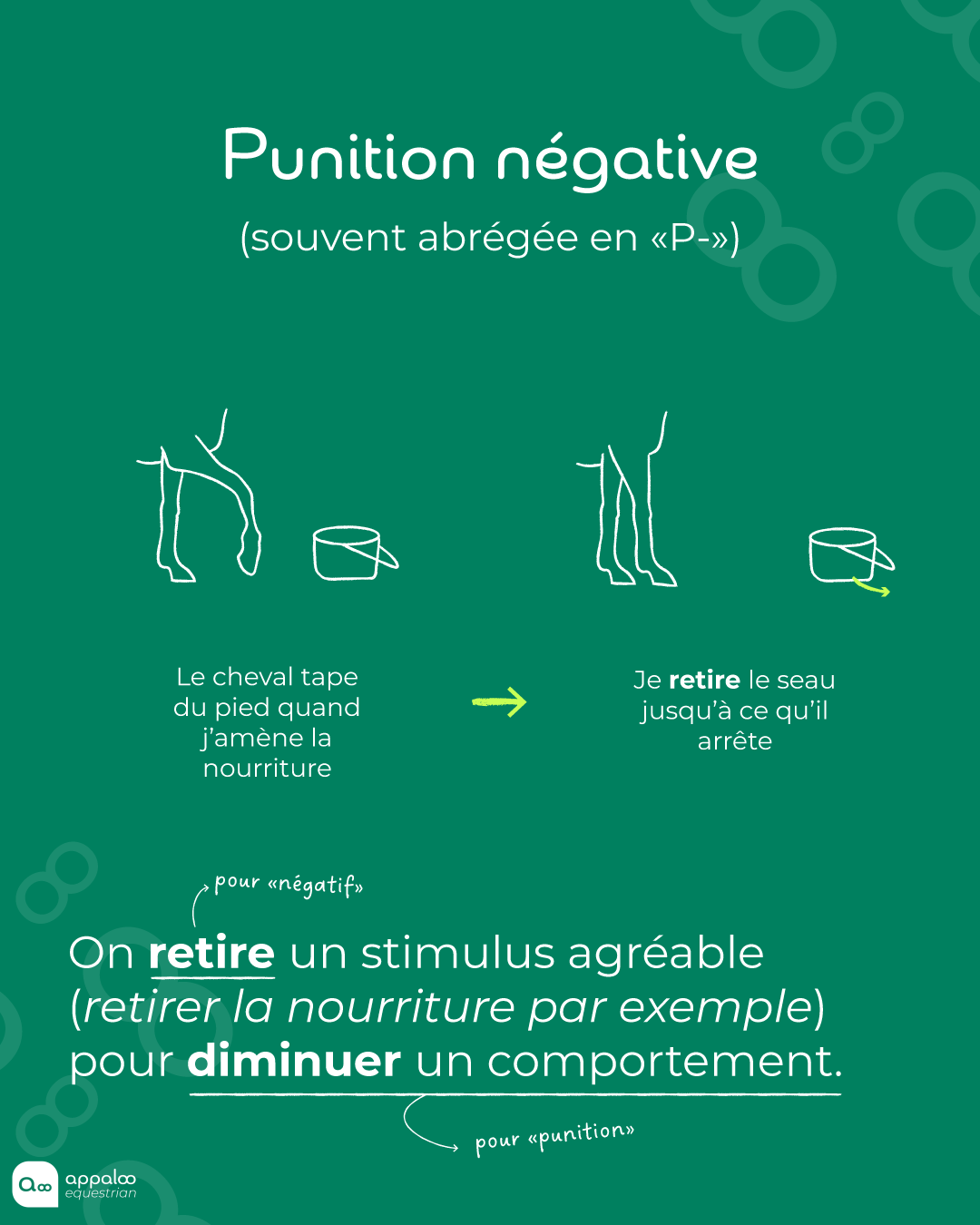
Example: your horse stamps his foot when you bring his feed. You move the bucket away until he stops. The food disappears when he stamps: the behavior decreases.
Positive punishment (P+)
An unpleasant stimulus is added to decrease a behavior.
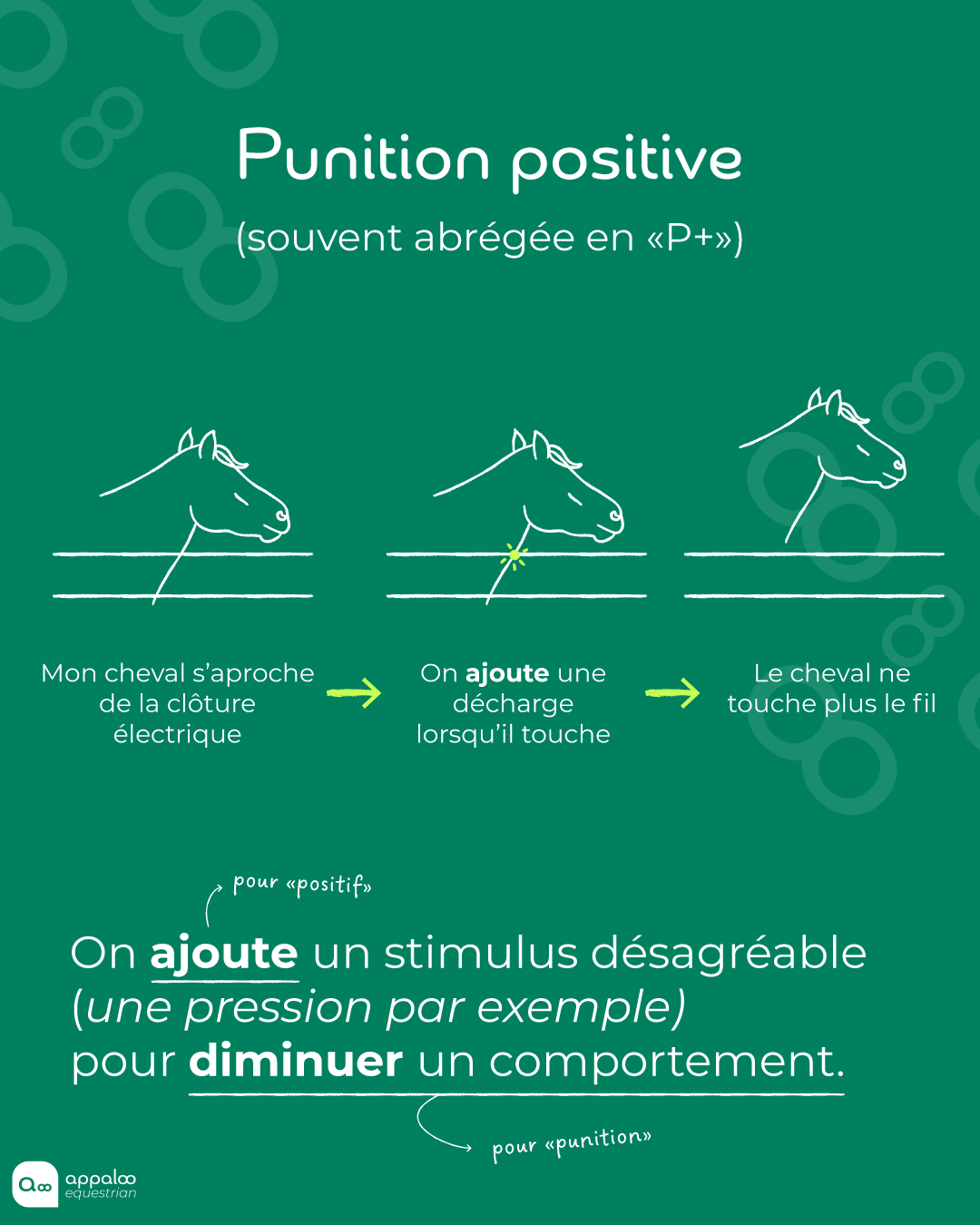
Example: your horse approaches the electric fence and receives a shock when touching it. Result: it no longer touches the wire. No human is needed for P+ to occur: the environment handles it very well.
Important reminder
Punishment does not always teach the horse what to do instead. A horse punished for stamping its foot knows what it must not do, but not what is expected of it. This is why it is so important to teach primarily through reinforcement: rewarding the horse that waits calmly for its feed is often more effective than punishing it for stamping.
Also beware of the common confusion between R- and P+: both use pressure, but one removes it to reinforce a response, while the other adds it to stop a behaviour.
R+, R-, P+, P-: the summary table
The four quadrants of learning can be summed up in two questions: are we adding or removing something? And do we want to increase or decrease the behaviour?
Primary or secondary reinforcer: what is the difference?
There are two types of reinforcers: the primary reinforcer, which directly meets an essential need, and the secondary reinforcer, which becomes enjoyable through learning.
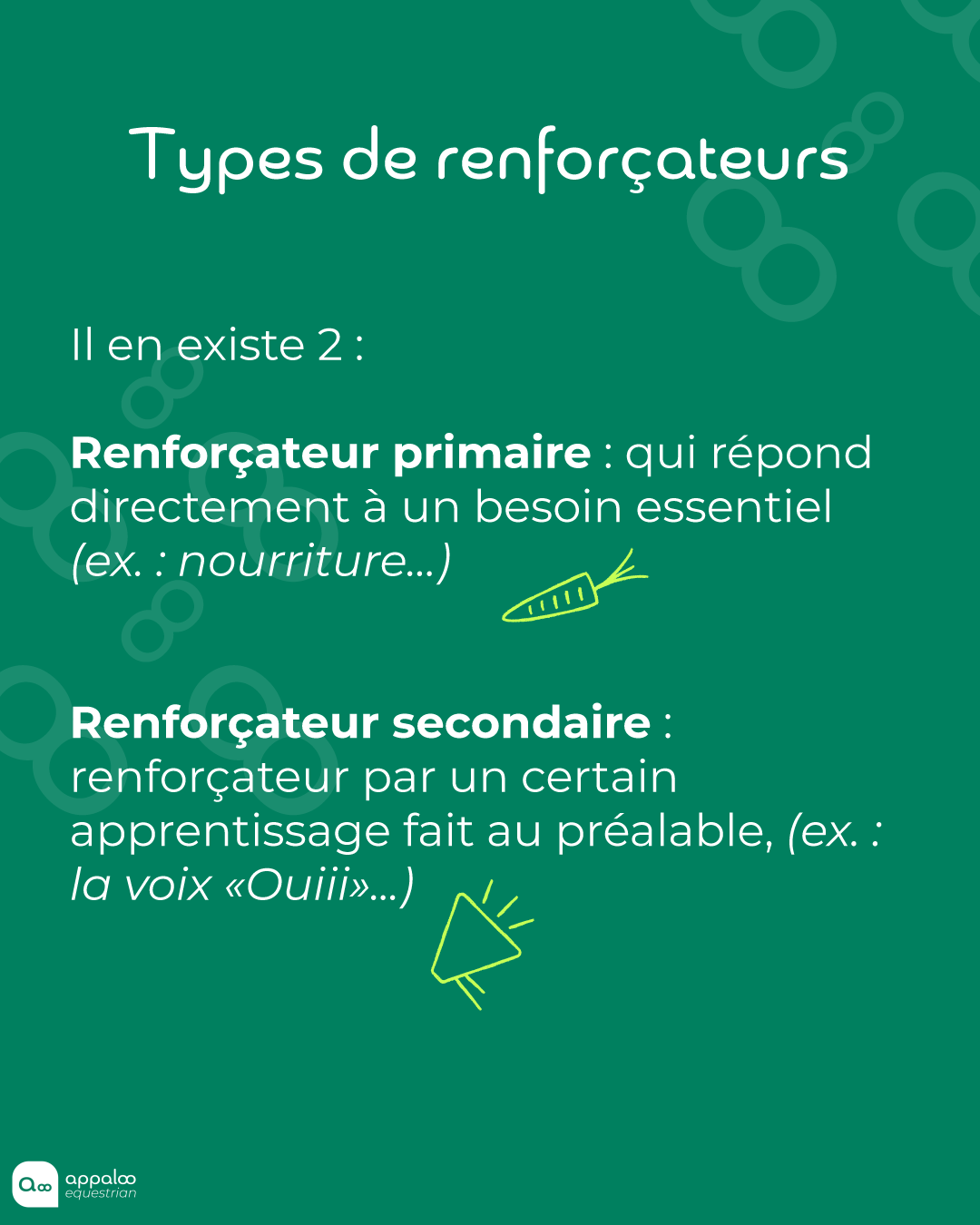
Primary reinforcer: it directly meets an essential need of the horse, such as food. There is no need to teach them that a carrot is good!
Secondary reinforcer: it has no value at first, but acquires one through prior learning. For example, your voice saying “Yesss”, or the sound of a clicker.
To create a secondary reinforcer, it is paired several times with the primary reinforcer: “Yesss” → treat, “Yesss” → treat… After a while, the horse understands that this sound announces something good. This is the whole principle of clicker training: the click marks the correct behaviour to the second, then the reward follows. The clicker also makes it possible to mark a response from a distance, which is very useful when working at liberty or on the lunge.
R+ or R-: what science says
Studies show that horses trained with R+ seek more human contact and learn at least as well, without meaning that properly used R- should be ruled out.
The horse remembers who rewarded them. At the University of Rennes, ponies learned to back up to the voice, either through R+ or R-. The ponies in the R+ group sought more contact with humans after training, and learned better. The ponies in the R- group sought less contact (Sankey et al., 2010a).
This effect lasts over time. In young horses, associating a reward with an exercise increased their interest in humans, including several months later, and even towards unfamiliar people (Sankey et al., 2010b).
A little R+ is enough to make a difference. In a Swedish study, owners added around 20 minutes of R+ per week for 8 to 9 weeks, while maintaining their usual R- work. Their horses then sought more contact with an unfamiliar person (Larssen & Roth, 2022).
R+ also helps horses with a difficult past. In ponies rescued after neglect or abuse, incorporating R+ into the rehabilitation programme appeared to benefit their welfare (Innes & McBride, 2008).
Conversely, equitation science researchers point out that R- remains at the heart of riding, and that it can be ethical if applied correctly: light pressure, immediate release, and a horse that is never set up to fail (McLean & Christensen, 2017). Many riders therefore combine the two: R- for the aids, R+ to motivate, reassure and teach new things.
R+ exercises on Appaloo
On Appaloo, you will find groundwork and ridden exercises that can be carried out according to your training method, whether you mainly work with R-, R+ or a combination of both.
We also have a few “Full R+” exercises in the app, submitted by our members. And you too can submit your own so that we can add them to the catalogue, directly from the app!
Appaloo Equestrian is the collaborative app for your riding sessions: discover, share, plan and analyse to progress with your horse.
Feel free to share this article with your yard mates so that everyone can finally understand the true meaning of R+, R-, P+ and P-!
FAQ: your questions about R+ in equestrianism
What does R+ mean in equestrianism?
R+ is short for “positive reinforcement”. Something pleasant for the horse, such as a treat or a scratch, is added immediately after a behaviour so that the horse repeats it more often.
What is the difference between R+ and R-?
Both are used to increase a behaviour. With R+, something pleasant is added. With R-, something unpleasant is removed, most often pressure from the leg, rein or lunge line.
Is R- abusive?
No. “Negative” simply means that a stimulus is removed. When applied correctly, with light pressure released at the right moment, R- is the basis of the aids in riding. It is strong, sustained pressure or pressure without release that causes a problem.
What is the difference between R- and P+?
R- removes pressure to mark a correct response, and therefore increases a behaviour. P+ adds something unpleasant to stop a behaviour. The same tool, pressure, can therefore serve one purpose or the other depending on when it is added or removed.
Can you ride a horse using full R+?
Yes, some riders train and ride their horses almost exclusively with R+. This requires gradual learning and a great deal of consistency. Most riders combine R+ and R- in their daily work.
Does R+ make a horse bite or beg?
Not if it is properly structured. The horse must learn that the reward comes after the marker (click or “Yesss”), and never when it searches through pockets. Rewarding calmness and politeness is part of the learning process.
What is clicker training?
It is an R+ method that uses a small device that makes a “click” sound. The click becomes a secondary reinforcer: it marks the correct behaviour at the precise moment, then the treat follows.
Scientific sources
Innes, L. & McBride, S. (2008). Negative versus positive reinforcement: an evaluation of training strategies for rehabilitated horses. Applied Animal Behaviour Science, 112(3-4), 357-368.
Larssen, R. & Roth, L. S. V. (2022). Regular positive reinforcement training increases contact-seeking behaviour in horses. Applied Animal Behaviour Science.
McLean, A. N. & Christensen, J. W. (2017). The application of learning theory in horse training. Applied Animal Behaviour Science, 190, 18-27.
Sankey, C., Richard-Yris, M.-A., Henry, S., Fureix, C., Nassur, F. & Hausberger, M. (2010a). Reinforcement as a mediator of the perception of humans by horses (Equus caballus). Animal Cognition, 13(5), 753-764.
Sankey, C., Richard-Yris, M.-A., Leroy, H., Henry, S. & Hausberger, M. (2010b). Positive interactions lead to lasting positive memories in horses, Equus caballus. Animal Behaviour, 79(4), 869-875.
Skinner, B. F. (1953). Science and Human Behavior. New York: Macmillan.
Takahashi, A., Nishiyama, K., Ohkita, M. & Sawa, K. (2016). Failure to find reinforcement effect of neck patting in horses (Equus caballus). Psychologia, 59(2-3), 91-99.
Warren-Smith, A. K. & McGreevy, P. D. (2008). Equestrian coaches' understanding and application of learning theory in horse training. Anthrozoös, 21(2), 153-162.