Whether you’re a novice rider or an experienced one, knowing the dressage arena letters inside out is an essential skill. These markers aren’t there by chance (even if their order might make you think otherwise!): they help you ride accurate lines and allow you to execute the prescribed movements correctly in your tests (or during your own schooling sessions).
In this article, we explain where the letters are placed (around the track and on the centre line), the distances between them, and some mnemonics to help you learn them once and for all!
1. Arena dimensions and letter layout
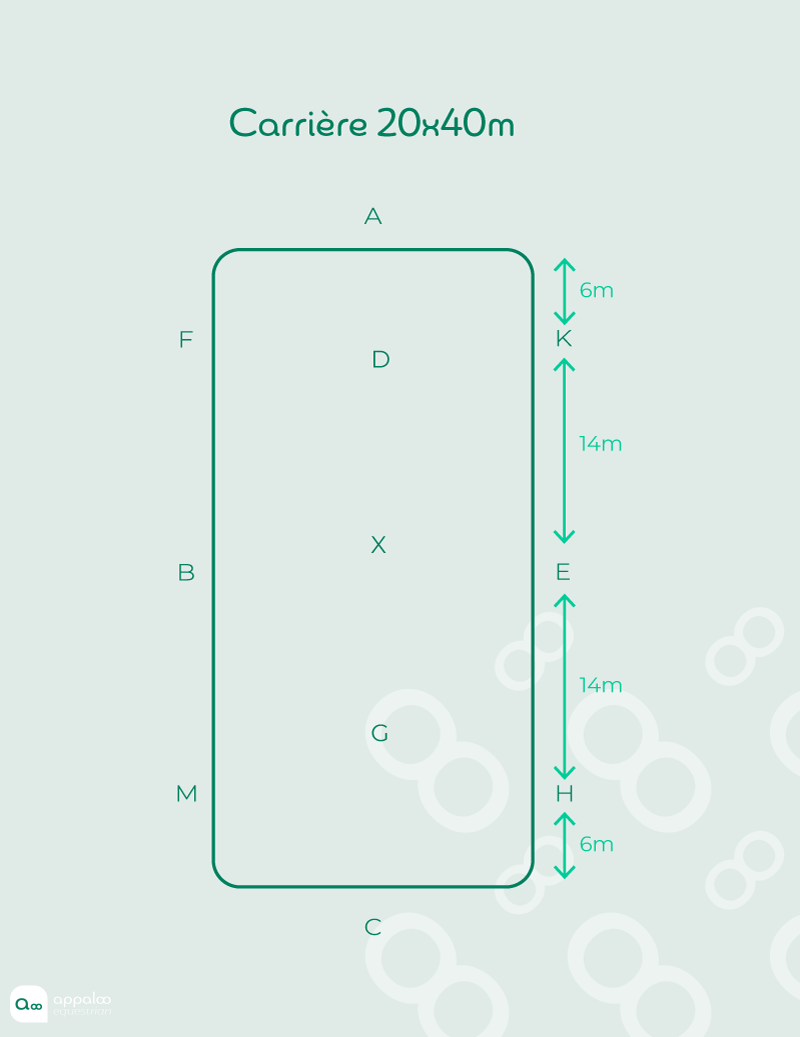
20 × 40 m dressage arena
This small arena is often used in riding schools and for beginner/intermediate levels. The letters around the perimeter are:
A – K – E – H – C – M – B – F (clockwise from the entrance).
In the centre, the following are also used: D – X – G on an imaginary line.
To picture it:
- A = Entrance
- C = Opposite A, where the judge is often seated
- X = Exact centre of the arena
- D / G = Markers on the centre line between A, X and C
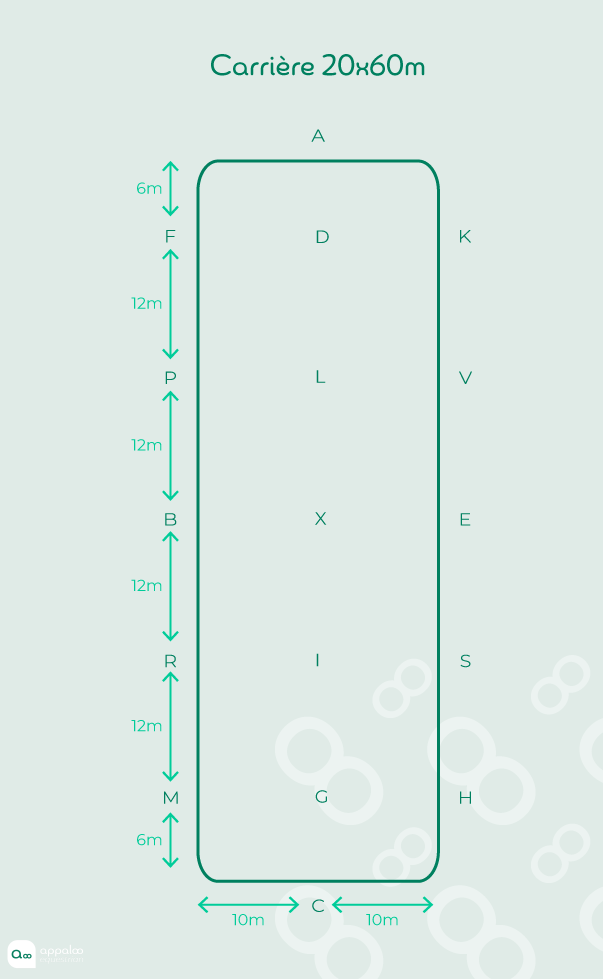
20 × 60 m dressage arena
This is the standard size for competitions and more advanced levels. It has more letters around the track:
A – K – V – E – S – H – C – M – R – B – P – F.
And on the centre line: D – L – X – I – G.
Key points to remember:
- The centre line is slightly longer, hence more letters in between.
- X remains the main working point, often used for halts, transitions and school figures.
2. Distances between letters (practical markers)
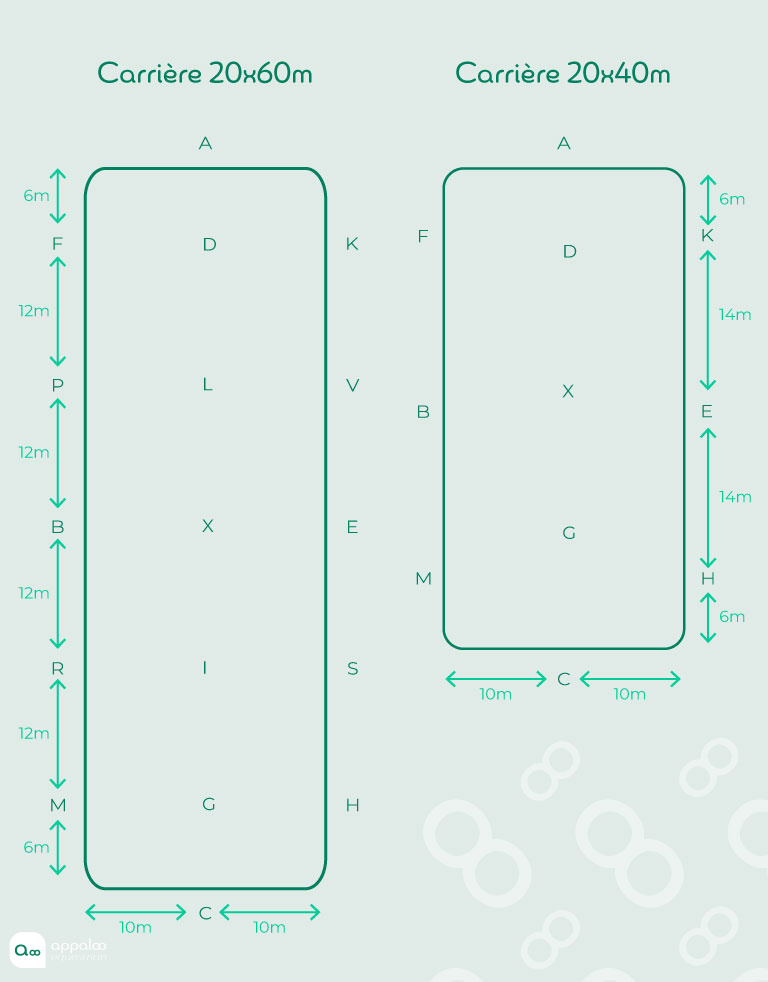
Here are some useful markers to estimate distances during your schooling sessions:
Small arena 20×40 m:
- Between the letters on the long side (K ↔ E and B ↔ F): about 14 m each.
- The letters H and M are placed about 6 m in from the corners. These markers help you set up your turns and circles accurately.
Large arena 20×60 m:
- The letters are spaced about 12 m apart along the long sides, and 6 m in from the corners.
3. Centreline letters: why they matter
Unlike the letters on the track, those on the centreline are not physically marked on the ground, but they are crucial for:
- square halts and accurate transitions;
- precision movements;
- accurate bending lines.
Centreline in a 20×40 m arena: A → D → X → G → C
Centreline in a 20×60 m arena: A → D → L → X → I → G → C
These letters provide essential reference points for dressage tests and for riding accurate figures.
4. Mnemonic tips for memorising the letters
It’s often hard to remember the “random” order of the letters… but nothing’s impossible with a good mnemonic!
Finding an easy phrase to remember can be a fun and educational way to learn the order of the dressage letters. (We always remember best the phrases we’ve invented ourselves!)
Some examples:
- Kelly Valets Every Schooling Horse
- Aids Delicate and Light at X boost the Intelligence and Good nature of the Cob
- Forget Pink Bubbly Rosé in the Morning
- Ah, Keep Viewing Every Spanish Hack! Clearly My Royal Bent-Backed Patchy Freak!
5. Our practical tips to learn fast
- Draw the arena on paper and write in the letters, several times, until it becomes automatic.
- Walk the arena on foot while saying the letters out loud.
- During warm-up, ride simple exercises such as “halt at letter X” or “10 m circle around E”. These little games naturally improve your accuracy and your memory.
Conclusion
Knowing the dressage arena letters, their placement and the distances between them is a real asset for your progress. It’s the foundation of an accurate line, of precise execution of school figures, and of effective schooling sessions. With a few simple mnemonics and some practice, you’ll remember them quickly and be able to ride with even more confidence.
Our tip: in the Appaloo app, you can visualise your flatwork exercises in the arena and track your progress from one schooling session to the next.
Find out how to easily plan your next schooling session!